

Is the Intel Core Ultra 9 285K CPU Good for Audio Production?
Audio producers live in the intersection of low latency, high track counts, and complex plugin chains. The Intel Core Ultra 9 285K is Intel’s latest flagship Arrow Lake-S processor, and it brings a suite of features tailor-made for modern DAWs. Thanks to a hybrid architecture with 8 performance-cores (P-cores) and 16 efficient-cores (E-cores), a massive 40 MB of L2+36 MB of L3 cache, and up to 5.7 GHz turbo, the 285K balances single-thread responsiveness with multithreaded throughput. Whether you’re tracking dozens of virtual instruments or rendering a final mix, the Core Ultra 9 285K delivers the horsepower, headroom, and stability that pro audio demands.
Table of Contents
In this article we will help you answer the question, "Is the Intel Core Ultra 9 285K CPU Good for Audio Production?"
Short answer, absolutely. This is Intel's best performing CPU yet for audio production and digital creatives. Let's dive into the nuts and bolts.
Intel Core Ultra 285k Hybrid Core Architecture and Intelligent Scheduling
At the heart of the 285K is Intel’s Thread Director, which dynamically assigns time-sensitive audio tasks to the P-cores and hands off background processes to the E-cores. In practice, this means:
- P-cores handle your real-time audio engine and low-latency monitoring
- E-cores run file backups, antivirus scans, sample-library streaming, and other background chores
- Integrated Thread Director ensures seamless core hand-offs without audible buffer pops
This intelligent division of labor keeps your DAW’s critical audio path rock solid, even under heavy loads.
Intel Core Ultra 285k Single-Thread Performance: The Bedrock of Low Latency
Despite the appeal of many cores, audio production still relies heavily on strong single-thread performance. From real-time convolution reverbs to pitch-shift algorithms, many plugins execute most efficiently on a single fast core. The Core Ultra 9 285K delivers:
- 3.7 GHz P-core base and 5.7 GHz max boost
- Lion Cove P-cores with 3 MB L2 cache each for lightning-fast context switches
- Exceptional IPC uplift over previous generations
In daily use, you’ll experience reduced buffer sizes—often down to 64 samples or lower—without CPU crackle.
Intel Core Ultra 285k Multi-Threaded Muscle for Mixing and Rendering
When it’s time to bounce tracks or run batch exports, all 24 threads of the 285K shine. Large orchestral mockups, complex stems, and hybrid mixes thrive on its 24-thread design:
- 16 E-cores can tackle non-real-time processing tasks in parallel
- 40 MB of fast cache minimizes data fetch latency between cores
- Up to 125 W TDP under load keeps the system within pro-audio thermal envelopes
Mix sessions that once took 15 minutes can often be rendered in a fraction of the time, freeing you to focus on creative tweaks instead of watch meters.
Intel Core Ultra 285k Lightning-Fast Memory and Storage
Audio producers are no strangers to huge sample libraries and stream-friendly SSDs. The Core Ultra 9 285K’s modern platform unlocks:
| Feature | Benefit for Audio Production |
|---|---|
| Dual-channel DDR5-6400 | Faster sample loading, smoother Kontakt patches |
| PCIe 5.0 NVMe support | Sub-second project and template load times |
| Up to 192 GB ECC memory | Large sample sets without swapping or dropouts |
With these specs, orchestral libraries and convolution IRs stream instantly, eliminating crackles caused by disk I/O bottlenecks.
Intel Core Ultra 285k Built-In AI Acceleration for Next-Gen Plugins
The integrated Neural Processing Unit (NPU) in the 285K delivers up to 37 TOPS of AI performance. This silicon is ideal for:
- Real-time spectral repair (denoise, de-clip, de-reverb)
- Intelligent mastering assistants and automated EQ/comp routing
- Machine-learning-driven synths and creative effects
Offloading these tasks to the NPU frees CPU cores for your core audio engine and complex plugin chains.
Intel Core Ultra 285k Thermal Efficiency and Studio-Quiet Operation
Pro audio rigs demand stability and low noise. The 285K’s Arrow Lake architecture brings:
- Improved power efficiency over Raptor Lake predecessors
- A manageable 125 W peak TDP and 55 W PL1 envelope for sustained loads
- Compatibility with advanced liquid-cooling solutions and PCAudioLabs’s ROK BOX MC X PRO custom build
In a well-tuned studio PC, fans rarely spin at full tilt, ensuring silent tracking and mixing sessions.
Intel Core Ultra 285k Real-World Case Study: PCAudioLabs ROK BOX MC X PRO
PCAudioLabs’s ROK BOX MC X PRO desktop is a turnkey example of the 285K in action.
Key specs include:
- Core Ultra 9 285K at 5.7 GHz with 24 cores/threads
- Gigabyte Z890 chipset with custom liquid cooling
- 64 GB DDR5-6400 dual-channel RAM
- Three NVMe drives (1 TB OS + 2 × 2 TB audio & samples)
- Windows 11 Pro, balanced for low-latency audio
Studio One, Cubase, Ableton Live, Pro Tools, and other DAWs all benefit from this balanced, high-performance configuration—delivering rock-solid playback and massive track counts.
Intel Core Ultra 285k DAWBench DPC Latency Tests for Pro Audio Production
In our tests using DAWBench and Cockos REAPER Digital Audio Workstation, the Intel Core Ultra 9 285k CPU performed very well.
You may review our DAWBench CPU latency tests for pro audio production in their entirety by clicking here.
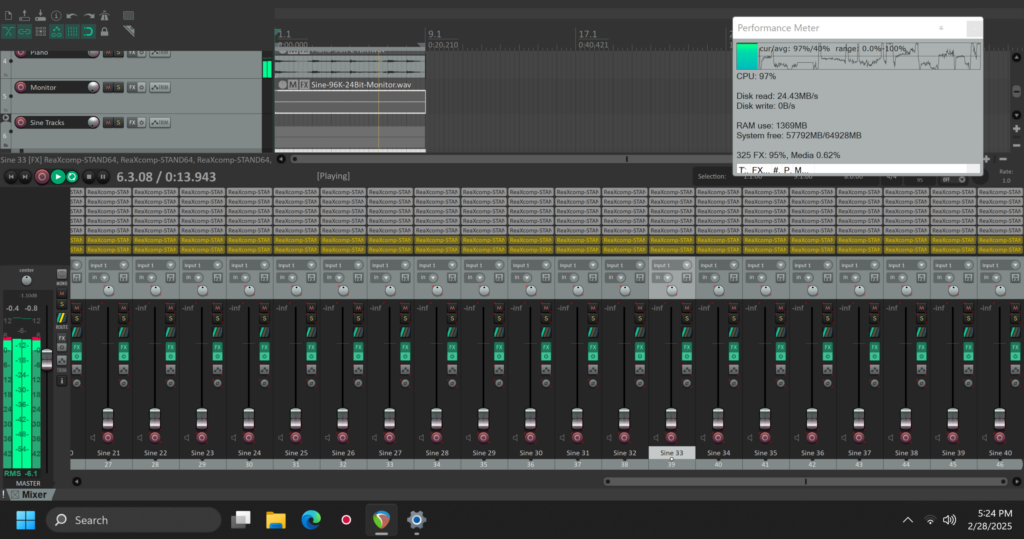
In DAWBench DSP DPC latency test results, with the audio interface buffer size set to 16 samples and a 44.kHz audio engine, the Intel Core Ultra 9 285k CPU was able to instantiate 400 REaxComp Multiband Compressor plugins across 40 channels of audio playback:

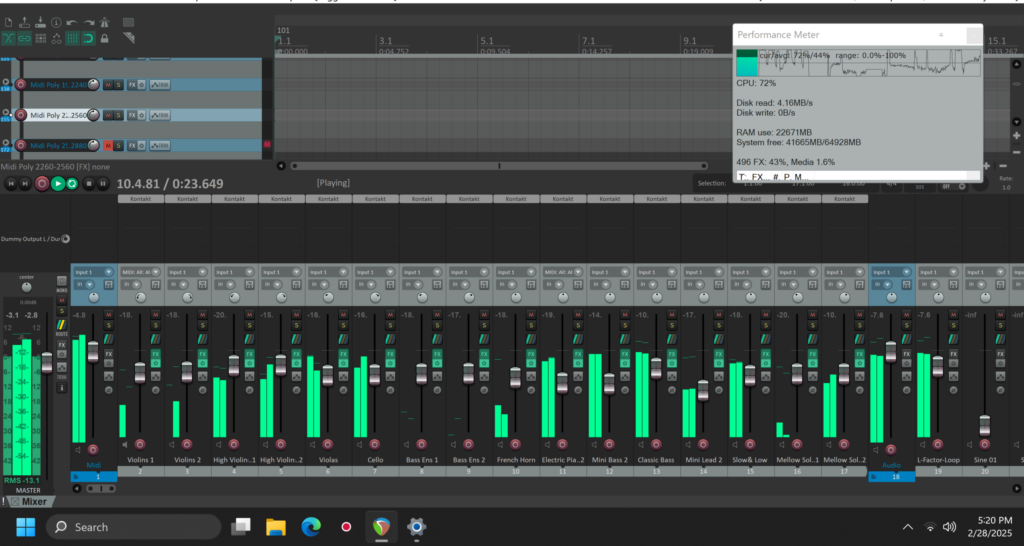
In DAWBench's Virtual Instrument tests, which focus on voice polyphony using multiple instantiations of Native Instruments Kontakt, the Intel Core Ultra 9 285k CPU was able to support a low end voice polyphony of 2240 voices and a high end of 9600 voices with a 44.1kHz/16 sample buffer setting:
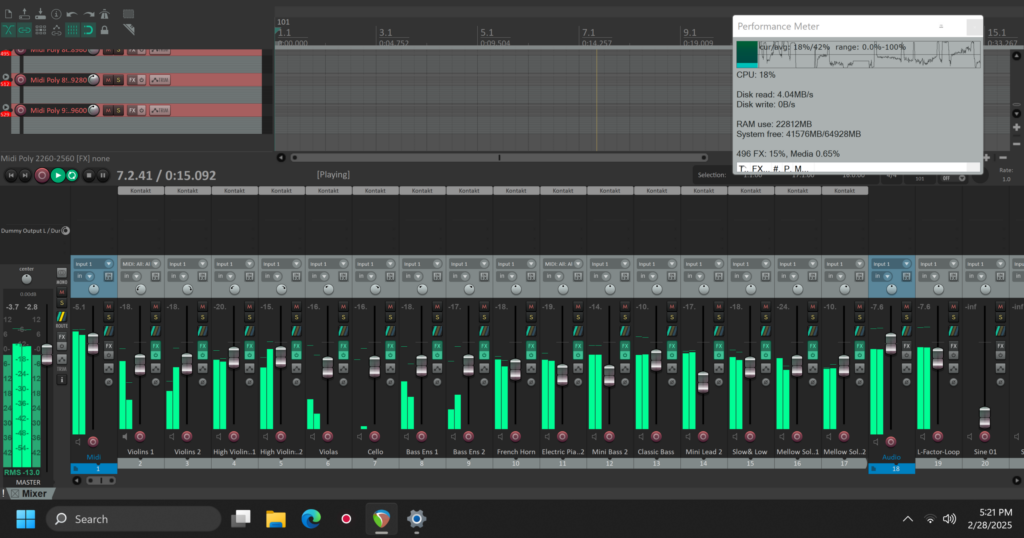
The CPU also performed well at 96kHz with virtual instrument voice polyphony, with 940 voices at a 32 sample buffer, and 9600 voices at a 1024 sample buffer.

Intel Core Ultra 9 285k Cinebench Test Results
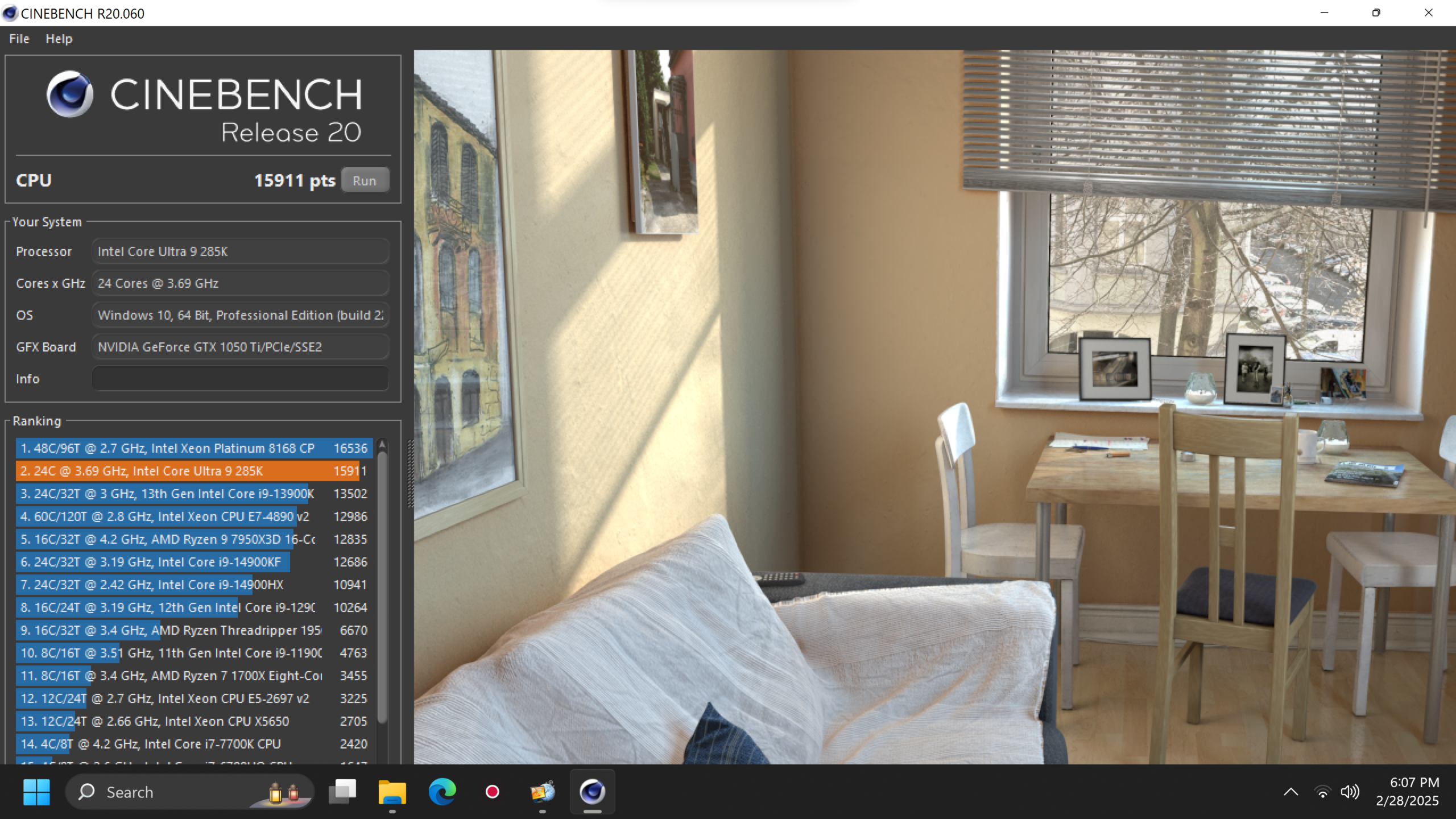
The Intel Core Ultra 285k CPU also performed well in Maxon Cinebench tests:
Intel Core Ultra 9 285k Passmark Score
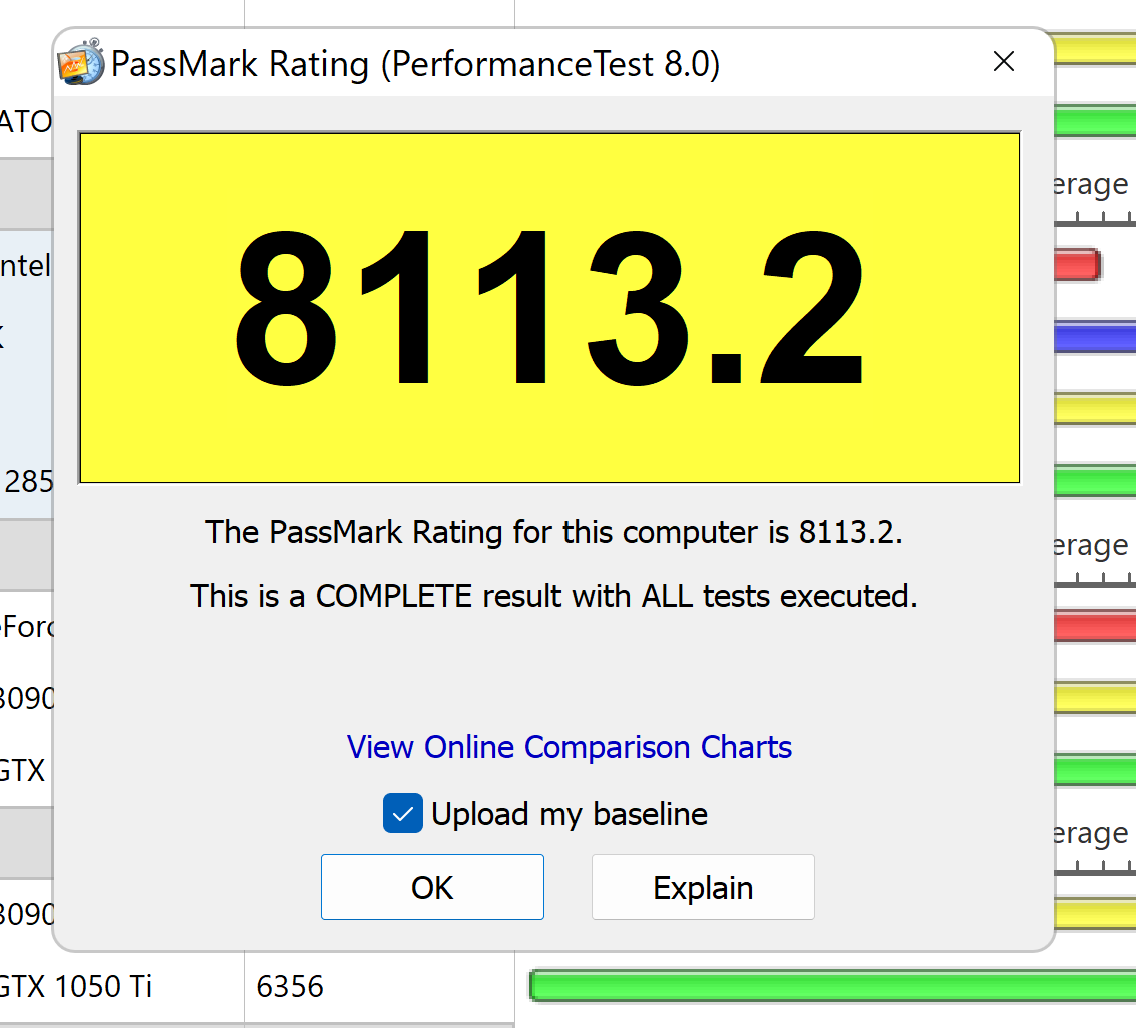
The Intel Core Ultra 9 285k CPU scored 8113.2 points on Passmark's Performance Test score in our Rok Box MC-X Pro Audio PC configuration.
Conclusion
For audio professionals and serious hobbyists, the Intel Core Ultra 9 285K offers a rare blend of great single-core responsiveness, multithreaded strength, AI offloading, and modern I/O headroom. Whether you’re building your first pro audio rig or upgrading an aging system, the 285K elevates your workflow by shrinking load times, expanding track counts, and keeping latency down to a whisper. In today’s competitive audio landscape, that headroom and reliability can be the difference between a good session and a great one.