
Summary
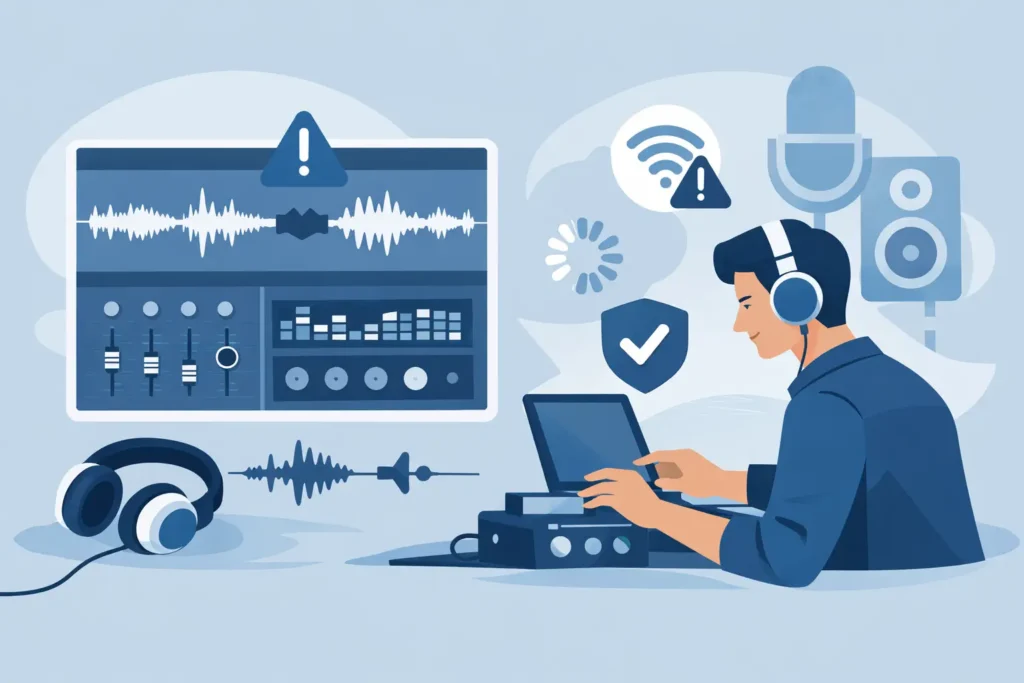
Audio dropouts—manifesting as pops, clicks, or sudden silence—occur when a computer system cannot process real-time audio fast enough. Unlike general computing, digital audio workstations (DAWs) require zero-latency consistency rather than high peak benchmark numbers. Preventing these drops requires a balanced, optimized system rather than a single setting adjustment.
A session can feel solid right up until the first pop, click, or silent gap during playback or recording. If you are trying to figure out how to prevent audio dropouts, the answer is rarely one single setting. In most professional setups, dropouts happen when the computer, interface, driver, storage, or plugin chain cannot keep up with the workload in real time.
That distinction matters because audio work is not like general office computing. Your DAW does not get the luxury of waiting a few extra milliseconds while Windows handles a background task or a driver misbehaves. When you are tracking vocals at low latency, running a dense mix, or printing stems on a deadline, consistency matters more than peak benchmark numbers.
What causes audio dropouts in a DAW?
At a technical level, a dropout means the system failed to deliver or process audio data fast enough. That can happen because the buffer is too low for the workload, the interface driver is unstable, a plugin spikes CPU usage, or the storage drive cannot stream files reliably. Sometimes the issue is obvious. Often it is cumulative, with several small inefficiencies adding up until the session breaks.
This is why a machine that looks powerful on paper can still struggle in production. High core counts and big memory numbers help, but they do not guarantee low-latency stability. Audio sessions reward balanced systems, proven compatibility, and proper optimization.
How to prevent audio dropouts at the system level
The first step is to look at buffer size in context. During recording, especially with software monitoring or virtual instruments, you usually want a lower buffer to keep latency under control. During editing or mixing, that same low buffer can become a liability because the CPU has less time to process plugins and route audio. If you leave the buffer at an aggressive setting throughout the entire project, dropouts become much more likely.
A practical approach is to work in stages. Track at a lower buffer when performance demands it, then raise the buffer once you move into heavier editing or mixing. That is not a workaround. It is standard workflow management for real-time audio.
Driver quality is the next major factor. On Windows systems, your audio interface should be running its proper ASIO driver, not a generic fallback if a dedicated option exists. Interface drivers vary widely in maturity, efficiency, and stability. Two units with similar specs can behave very differently under load because the driver stack is doing more of the real work than many users realize.
If dropouts started after a driver update, do not assume newer is automatically better. Some updates improve compatibility, while others introduce issues with specific DAWs or chipsets. In critical production environments, stability is worth more than chasing every new release.
CPU spikes are often the real problem
A DAW can show moderate average CPU usage and still drop audio. That is because real-time processing is vulnerable to momentary spikes, not just sustained load. One badly behaved plugin, an oversampling setting buried in a mastering chain, or a virtual instrument with heavy disk streaming can create short bursts that break playback.
This is where troubleshooting needs to be methodical. Bypass plugin groups rather than removing one random insert at a time. If the problem disappears when a bus chain is disabled, you have narrowed the search quickly. Linear-phase processors, look-ahead dynamics tools, convolution reverbs, and some AI-assisted or resynthesis tools are frequent culprits, especially at lower buffers.
Freezing or printing tracks can be the right decision, not a compromise. In professional sessions, conserving real-time resources is part of maintaining reliability. The trade-off is flexibility. If you are still deep in creative revision, freezing too early can slow you down. But if a project is nearing approval, committing heavy processing can make the whole session more dependable.
Storage and sample streaming matter more than many users think
Audio dropouts are not always a CPU story. Large multitrack sessions, orchestral templates, and sample-heavy productions can hit the storage subsystem hard. If projects, sample libraries, and the OS are all fighting for bandwidth on a slower or overloaded drive, streaming performance can suffer.
NVMe SSDs have made this far less painful than it used to be, but drive layout still matters. A dedicated system drive and separate high-speed storage for sessions or libraries can improve consistency, especially in demanding workflows. The exact gain depends on the kind of work you do. A singer-songwriter session with modest track counts will stress storage differently than a dense post-production session or a scoring template with large sample sets.
Capacity also plays a role. SSDs that are nearly full tend to perform less consistently, and heavily fragmented project management can make troubleshooting harder. Keeping active sessions and libraries on fast, healthy drives is basic studio hygiene.
Windows optimization still plays a role
When people ask how to prevent audio dropouts, they often expect a DAW-only fix. In reality, the operating system and hardware environment matter just as much. Background tasks, aggressive power management, wireless drivers, and poorly behaved USB devices can all interrupt audio processing.
Power settings deserve special attention. A system that keeps trying to save energy by parking cores or throttling performance can create instability in low-latency work. The goal for a production workstation is predictable performance, not maximum battery-style efficiency. That is particularly true for mobile rigs and compact systems where thermal and power behavior must be managed carefully.
USB topology can also create problems. If your interface shares resources with other demanding peripherals, you may see intermittent issues that look like software faults. Try simplifying the chain. Disconnect nonessential USB devices, avoid low-quality hubs for critical audio hardware, and test interface placement on different ports if the motherboard provides multiple controllers.
Wireless networking and Bluetooth are another variable. Some systems handle them cleanly, others do not. If you are troubleshooting stubborn dropouts during a session, temporarily disabling them can help confirm whether driver activity is contributing to the problem.
Why purpose-built hardware helps prevent audio dropouts
This is where workstation design matters. Audio production is sensitive to combinations of components, firmware behavior, chipset compatibility, thermal tuning, and driver interactions. A generic consumer PC may be fast enough in broad terms, but that does not mean it has been configured or validated for low-latency creative work.
A purpose-built system reduces the guesswork. It starts with component choices that are known to behave well under DAW workloads, continues through BIOS and Windows optimization, and extends to testing with real interfaces, software, and plugin-heavy sessions. That is the difference between owning a fast computer and owning a reliable production tool.
For creators who do not want to spend billable time diagnosing DPC latency, interface instability, or unexplained USB behavior, that engineering work matters. PCAudioLabs has built its reputation around this exact problem: giving producers, engineers, and editors systems designed for dependable sessions rather than general-purpose computing.
A practical checklist for dropout troubleshooting
If you need to stabilize a session quickly, start with the variables most likely to change the outcome. Raise the buffer if you are mixing, confirm you are using the correct ASIO driver, bypass heavy plugins in groups, and move the project to a fast SSD if it is running from slower storage. After that, check Windows power settings, reduce unnecessary background processes, and simplify USB connections.
If those steps help but do not fully solve the issue, the pattern tells you something. Improvement after a buffer increase usually points to CPU or plugin pressure. Improvement after moving sessions or libraries points to storage throughput. Improvement after changing ports or disabling devices often suggests a driver or controller conflict. Good troubleshooting is less about guessing and more about isolating the bottleneck.
Preventing audio dropouts before they start
The most effective fix is not a fix at all. It is building a production environment that matches your workload from day one. That means choosing an interface with stable drivers, using storage that can handle your session size, keeping plugin management disciplined, and running a computer configured for DAW reliability instead of general consumer use.
There is no single magic setting that solves every dropout. Tracking a vocal at 64 samples, mixing a 150-track project, and running a large scoring template all stress the system in different ways. The common thread is that stable audio depends on balance. When the computer, interface, storage, and software are aligned, dropouts stop feeling random and start becoming preventable.
If your current setup keeps interrupting sessions, treat that as a system design issue, not just an annoyance. The time you save by avoiding troubleshooting often matters as much as the performance gains themselves.